
Veteran Owned & Operated

When the VA says “No,” your rights say “Go.” Holding the system accountable to the Secretary’s “New Attitude” Mandate.

As of 2026, federal law under H.R. 7112 will codify ten fundamental protections for every veteran. (Still awaiting final approval by the House and Senate). These pillars will ensure that the VA system serves you—not the other way around.
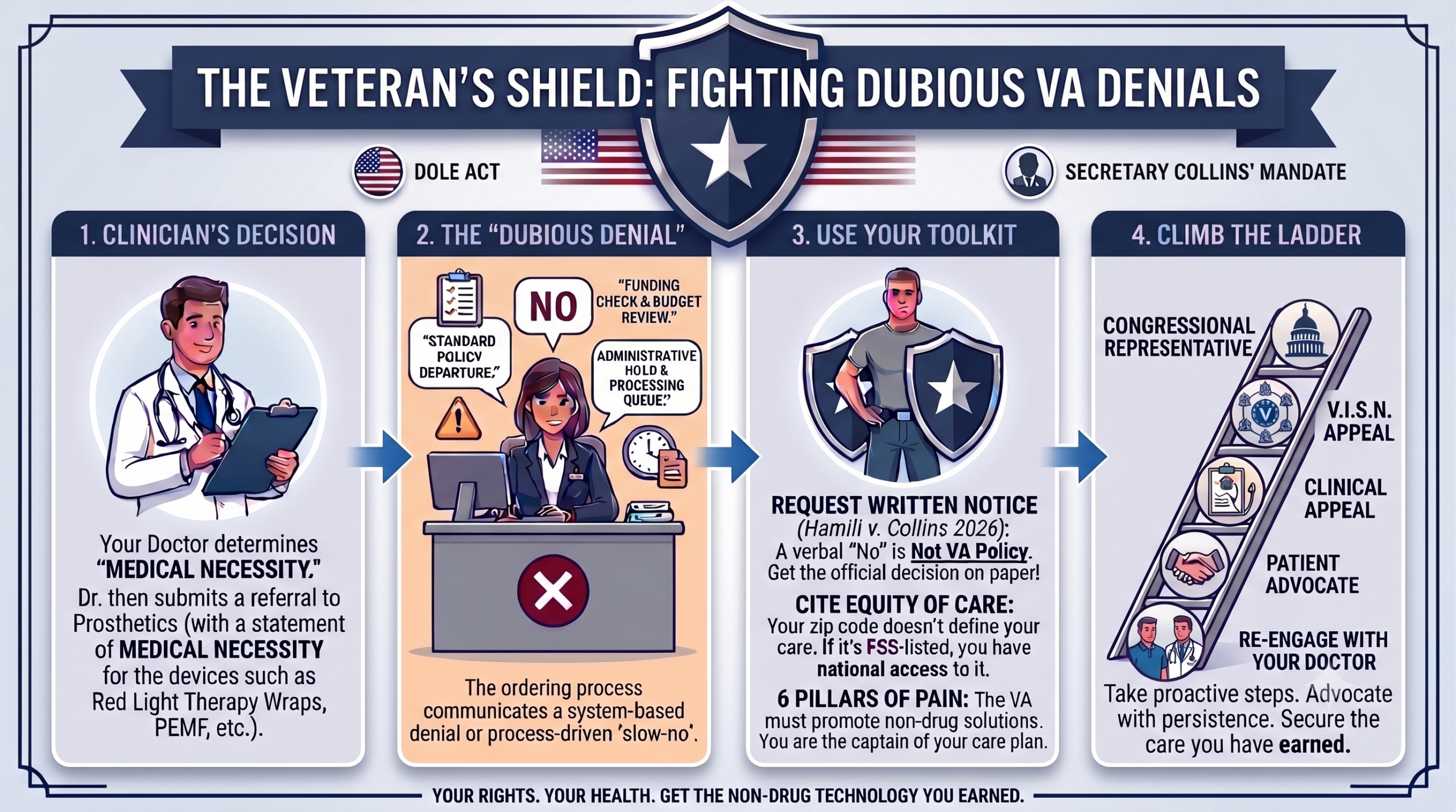
It can be challenging when a VA physician recommends a specific technology or device, only for the Prosthetics (PFAS) department to issue a denial. Understanding how to advocate for yourself within the system is key to ensuring your clinical needs are met.
A landmark Federal Circuit ruling, Hamill v. Collins (2026), has established greater accountability within the VA system by eliminating the "Implicit Denial" doctrine.

To effectively address a denial, it helps to understand the distinct boundaries between administrative and clinical responsibilities within the VA:
If the PFAS department denies a recommended device, you have formal avenues to ensure your case receives an appropriate medical review.

Under the Whole Health Mandate (VHA Directive 1137), you have the right to request advanced, non-pharmaceutical modalities that address the root cause of your condition.
Modern Modalities You Can Request:
Having the right words ready can help keep conversations with your local VAMC professional, clear, and focused on your care. These revised scripts are designed to be firm and informed without being confrontational.
The Goal: Move away from an informal "no" and secure a paper trail for a clinical appeal.
"My physician has determined this device is a medical necessity for my care. Under the Hamill v. Collins (2026) ruling, I understand that decisions require formal documentation rather than an informal verbal response. Could you please provide a written Notice of Denial so that I can review it and initiate a Clinical Appeal under VHA Directive 1173.01?"
The Goal: Remind them of alternative procurement pathways like the Federal Supply Schedule (FSS) without arguing over priorities.
"I understand that local contracts can sometimes be limited. However, because my doctor ordered this specific item, and since these devices are available on the Federal Supply Schedule (FSS), could we look into utilizing the FSS to fulfill this medically justified order?"
The Goal: Highlight national standards and the option for Community Care without sounding accusatory.
"Under current equity of care guidelines and provisions like the Elizabeth Dole Act, I want to ensure my treatment aligns with national standards. If this facility doesn't routinely provide this [Red Light Therapy/Neurofeedback/Migraine Therapy/etc.] device, could we look at procuring it via the FSS, or potentially setting up a Community Care referral to a provider who can?"
The Goal: Reassert your role in your own care team using established VA health philosophies.
"The VA’s 6 Pillars of Pain Management emphasize shared decision-making between patients and their providers. I am strongly looking to pursue a non-pharmaceutical path right now, and I’d like to focus on the specific technologies my care team and I have agreed are best for my treatment plan."
The VA’s National Pain Strategy and Whole Health Mandate are built on six pillars that shift the focus from "the pill bottle" to the veteran's quality of life.
The Core Mandate:
The VA is officially required to prioritize non-drug solutions as first-line treatments. Most importantly, these pillars state that you are an integral part of your care team. Your personal goals drive the treatment—and the VA has a responsibility to promote and provide the technology to achieve them.
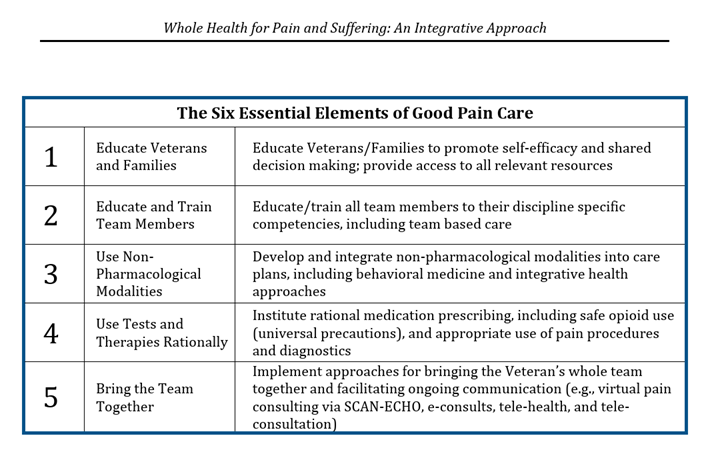
Science-Backed Modalities You Can Request:


The 2026 reorganization of the Veterans Health Administration (VHA) was launched with one specific goal: "To ensure veterans receive consistent, high-quality care regardless of the VA facility they visit."
The National Standard Mandate: Under the Elizabeth Dole Act and the Veterans’ Bill of Rights, the VA is legally prohibited from denying you a specific technology simply because "that branch doesn't do it."
In February 2026, the Federal Circuit issued a landmark ruling in Hamill v. Collins. For decades, the VA could "implicitly deny" a veteran by simply not responding or ignoring a doctor’s order.
The New Rule:
The VA can no longer give you a verbal "No" and walk away. Under Hamill v. Collins, a veteran has an appealable decision only if the VA provides an explicit, written notice.


If the front-line staff is not listening, move up the chain immediately:
The tech exists, and the coverage is there. Complete this 2 minute form to access sample VA verbiage and simple next steps.

At OPTI Vet Solutions, our mission is simple: help fellow Veterans take back their health and quality of life without relying on more medications.
Disclaimer At OPTI Vet Solutions, we’re Veterans helping other Veterans discover tools that can make a real difference. We’re not part of the U.S. Department of Veterans Affairs (VA) or any government agency – just sharing what’s worked for us and others in our community. Sometimes we earn a small commission when we help connect Veterans with products or technologies we believe in. That support helps us continue spreading awareness and education, but it never changes our message or mission. Everything shared here is for educational purposes only. Before starting any new therapy, device, or program, always talk with your healthcare provider. The final decision about using any health tool is between you and your care team.